Faculty Day Round-up
Lunchtime offered a plethora of poster exhibits on faculty scholarship and projects as well as a series of roundtables where thoughtful discussion focused on such issues as heritage languages, the impact of the New Jersey Nets' move to Brooklyn, new directions in interdisciplinary work, multiple literacies of popular culture, and the future of science at Brooklyn College. Mid-afternoon sessions piqued the artistic sensibility with music, sound, film, and dramatic presentations. The day wound down with more symposia covering public health, journalism, and high school reform, and concluded with an awards ceremony and reception at which faculty members were recognized for distinguis hed achievements in teaching, research, and service. (See "Honors and Awards," page 9.) Symposia  Paying Attention: Narrative and Perception in Hitchcock's RearWindow featured an examination of the 1954 film's take on consciousness from the perspective of the disciplines represented by moderator Geoffrey Minter, English, and panelists Lindley Hanlon, Film, Ellen Tremper, English, and Bill Seeley, Philosophy. Hanlon spoke of the profound and stunning interplay of the film's opening scenes, marveling at the free-wheeling camera movement, which offered a "space in time where science and fiction meet." Tremper targeted a "rear view" of Rear Window in her literary analysis of the film, noting that the homebound protagonist's (Jimmy Stewart) unresolved romance with the character portrayed by Grace Kelly frames his observations of his neighbors' behavior. Seeley's talk, "Imagining Film: Seeing with the Mind's Eye," dwelt on the seamlessness of Hitchcock's visual narrative--applying psychological and philosophical theories of how we process visual experience and reconstruct it--and drew upon theorie s of art and imagination from Kendall Walton and Gregorie Currie, among others. Paying Attention: Narrative and Perception in Hitchcock's RearWindow featured an examination of the 1954 film's take on consciousness from the perspective of the disciplines represented by moderator Geoffrey Minter, English, and panelists Lindley Hanlon, Film, Ellen Tremper, English, and Bill Seeley, Philosophy. Hanlon spoke of the profound and stunning interplay of the film's opening scenes, marveling at the free-wheeling camera movement, which offered a "space in time where science and fiction meet." Tremper targeted a "rear view" of Rear Window in her literary analysis of the film, noting that the homebound protagonist's (Jimmy Stewart) unresolved romance with the character portrayed by Grace Kelly frames his observations of his neighbors' behavior. Seeley's talk, "Imagining Film: Seeing with the Mind's Eye," dwelt on the seamlessness of Hitchcock's visual narrative--applying psychological and philosophical theories of how we process visual experience and reconstruct it--and drew upon theorie s of art and imagination from Kendall Walton and Gregorie Currie, among others.Crossing Boundaries: Building Learning Communities through Curriculum was moderated by Dean of Undergraduate Studies Ellen Belton, English, and addressed faculty initiatives to enhance teaching. Panelists Dorothy Kehl, English, and Nehru Cherukupalli, Geology, paired ESL and geology classes for group work on class assignments. In the ESL class, students worked on taking lecture notes and improving the reading and writing skills required for their geology class and complemented their study of earth materials and rocks by reading stories about the California gold rush and volcanic eruptions. In the geology class, students learned not only about the science of the formation of coal and oil but also some of the history behind the success of such industrialists as Andrew Carnegie and John D. Rockefeller. They learned to regard geologists as "detectives of the earth" and how efforts of the Japanese military to use the west-to-east jet stream to deliver bombs via balloons to the United States during World War II were foiled by the detection and identification of fine organisms in sand. Julia Hirsch and Joseph Entin, English, and Ray Allen, Mu sic, reported on "Voices Across America: Literature and Music," a collaboration of literature and music classes. In this learning community, English 2 sections were paired with a section of the core music course. The English sections focused on racial and cultural identity and stereotypes in texts, particularly in the movie version of Gershwin's Porgy and Bess. Entin introduced his students to the history of primitivism, first as a justification of imperialism from the sixteenth to the eighteenth century, then in terms of its treatment by writers of the Harlem Renaissance, and finally as a kind of backhand compliment in Porgy. Allen guided music students to find elements of the blues and spirituals in such songs as "It Ain't Necessarily So." Students looked at the interrelationship between sound structure in the music and depiction of social structures. Further discussion focused on comments by critics concerning the authenticity of Porgy and Bess . All the presenters expressed satisfaction with their collaborative efforts, and Hirsch noted that the opportunity was "an enriching and wonderful experience." Global Anti-Semitism: Sources and Prospects played to a standing-room-only crowd and featured session moderator Sara Re guer, Judaic Studies, and panelists Mervin Verbit, Sociology, and Robert D. Johnson and Steven P. Remy, History. Verbit's talk, "Anti-Semitism and Anti-Zionism," cautioned people to listen carefully when anti-Semitic or anti-Zionist views are being espoused and to challenge the user to define the terms. Anti-Semitism refers to actions that are harmful specifically to Jews, whereas anti-Zionism is a movement against the Jewish nation as a collective entity and to the right of Jews to have a national homeland. Anti-Zionism takes many forms: Some maintain that Jews are a religion, not a people, and a state based on religion is undemocratic; others deny the right of Jews to have a homeland because it occupies seized Arab land and is thus illegitimate; religious Zionism holds that Israel is not a true homeland because it was established as a secular state--only divine intervention can establish the Jewish state. Those who deny Israel legitimacy because they believe it is a place where non-Jews do not have equal rights should be confronted with the fact that Israel is a multiethnic democracy with a Jewish majority that grants the same rights and privileges to all citizens, including Arabs. Johnson discussed "Confro nting Anti-Israel Attitudes on Contemporary College Campuses," citing the imbalance of objective dialogue and discussion and using examples from Rutgers, Columbia, and other campuses that have Middle East departments with scholars who support a particular view without bringing objectivity and balance to the debate. He pointed to actions on campuses demanding divestment from companies doing business with Israel and to scholars who make unsubstantiated anti-Semitic and anti-Zionist claims. These campuses also tend to oppose conservative viewpoints and condemn conservatives as uninformed and backward. Johnson concluded that academic institutions should be teaching democratic values and human rights and building academic departments with scholars who are knowledgeable about the entire Middle East. Remy's talk, "Anti-Semitism in Contemporary Europe," argued that growing anti-Semitism in Europe is driven by conspiratorial theories and vestiges of twentieth-century totalitarianism and fascism. Radicals in some nations argue that the United States and Israel are imperialist countries trying to dominate the world. Increased immigration of Muslims from Arabic and African nations into Europe has also sparked a resurgence of anti-Semitism.
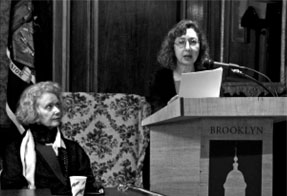
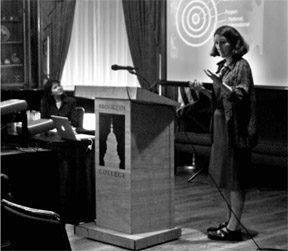
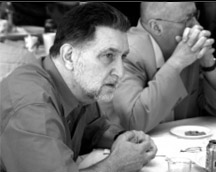
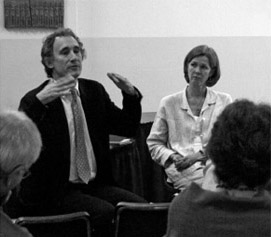
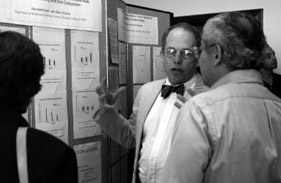
Jean Grassman (at podium) and Patricia Antoniello, Health and Nutrition Sciences. Peter Taubman and Hollyce Giles, Education. leads a roundtable on the impact of the Nets' move to downtown Brooklyn Political Science (far left), and Viraht Sahni, Physics. Health and Nutrition Sciences and Physical Education and Exercise Science, expounds on fuel stores and obesity. English and Honors Academy, at the Heritage Languages Roundtable Peaceful Teaching,Teaching Peace,
moderated by Elaine Brooks, English, featured panelists Geri DeLu ca, Len Fox, and Roni Natov, English, and David Forbes, Education. Natov spoke of the importance of establishing a group protocol in the classroom, encouraging students to talk and write in their own words and ensuring that all students are included. DeLuca, coordinator of the Writing Across the Curriculum program, related her experiences studying yoga over the years, explaining how the yoga concept of "radical self-acceptance" can be translated into helping students find their talents, accept themselves, and become less fearful. Fox discussed the central vision of peace education--that of a more peaceful world, which is the major theme of an ESL text, Making Peace, that he coauthored with Brooks. Forbes advocated the need for students to engage in contemplative activities in the classroom. Public Health without Borders: An International Perspective on Disease, moderated by Leslie Jacobson, Health and Nutrition Sciences, included panelists Patricia Antoniello, Jean Grassman, and Gerald Oppenheimer, Health and Nutrition Sciences. Antoniello's talk, "Against Women: AIDS, Global Policies, and Health Policies," covered the plight of minority and low-income women who experience racism, sexism, and class bias from the medical profession when trying to get help for AIDS. Pregnant women are no t informed of biomedical advances that can help them and are often advised to terminate their pregnancies to avoid giving birth to babies with AIDS.To gain better access to health services, these women have organized for collective action, forming groups to counsel other suffering women, initiating lawsuits, and fighting for humane treatment. Grassman's talk, "The Public Health Problems of Catastrophes: Russia, Italy, and the United States," explained that catastrophes result from a mix of factors that occur over time--noncommunication among involved principals, poor safety conditions, failure to follow procedures, mistakes, and other circumstances. She cited Chernobyl's nuclear reactor leakage in 1986, which spread radioactive materials over a wide area and caused death and illness; the Shelekov Fire in Italy (1992) and the dioxin release from a chemical plant in Seveso, Italy (1976); and the terrorist attacks on the World Trade Center (2001). She explored the mistakes made before and after the accidents and the changes required to avoid another occurrence. Oppenheimer spoke on "Shattered Dreams: Confronting the AIDS Epidemic in South Africa and the United States." It reflects his experiences as the coauthor of an oral history of the AIDS epidemic in S outh Africa: Five million of the country's 43.8 million people are HIV/AIDSpositive; 11 percent of South Africans are HIV-infected, and by 2010 adult HIV prevalence could reach 25 percent. An estimated 420,000 South African children are orphans as a result of the loss of parents to AIDS; by 2008, that figure is expected to reach 1.6 million. Oppenheimer stated that "in a society where, for many, basic day-to-day existence is already a struggle, AIDS is on a merciless rampage." He noted that South Africa has two kinds of medical facilities: the public medicine, which serves 70 percent of the people with 30 percent of the doctors, and the private, quality medicine, which serves 30 percent of the population with 70 percent of the doctors. Despite the end of apartheid, medical care is still based on class, race, and socioeconomic status. Understanding History: The Values of Interview and Survey Research, moderated by Jocelyn Wills, History, explored research methodology used by Philip Napoli, History, Alex Vitale, Sociology, and Robert Cherry, Economics. Napoli's research project, "War Talk: Brooklyn's Vietnam Veterans Remember," comprised data from taped interviews with Vietnam veterans from Brooklyn. He f ound similarities with the soldiers fighting today's war in Iraq: Both are mostly from working-class families, the children of first-or second-generation Americans, and are strongly influenced by neighborhood street gangs. He concluded that the Vietnam war his subjects fought "had one foot in Brooklyn." In "Challenges in Interviewing Government Officials: Investigating the Origins of 'Quality of Life' Policing," Vitale discussed the problems he encountered in interviewing officials for his research on homelessness and issues of urban life, which often required the reconstruction of political developments that occurred fifteen years earlier. He conducted interviews with police officials, mayors, city council representatives, and other politicians who seemed to have a tough time speaking concretely in terms of issues. To overcome these obstacles,Vitale used newspaper indices to determine actual events rather than relying on political speeches. He also developed a series of follow-up questions to present to his subjects and never taped his interviews because officials were not comfortable with a tape device. He advised researchers to always obtain institutional or individual approval when interviewing government or police officials. Cherry spoke on "Contentious History: Perceptions of Polish-Jewish Relations During World sp;War II." His focus was on members of Polish-American organizations, congresses, and museums because they had an interest in and knowledge of the events of past years. If they had not themselves experienced the events, they were the beneficiaries of family memories that were passed down over time. Cherry surveyed about three hundred people and conducted interviews with many others. He encountered terrific opposition to his research, however, with several organizations refusing to give him membership lists, requesting advance review of survey questions, and advising members to not participate in the survey. The research revealed, Cherry noted, that anti-Semitism was rampant among Roman Catholic Poles during the Second World War. Trying to Make Smaller Better: A Case Study in High School Reform was led by Stephen Phillips, Education, who presented a concise background on the small-school initiative designed to replace such huge failing high schools as Julia Richmond, James Monroe, and Erasmus with three to six small schools within the physical layout of the original school. Bushwick, one of the lowest-performing schools, where only one in every thirty-four students graduated with a diploma, was selected to be redesigned, an d Brooklyn College was asked to help. Several College faculty members served as facilitators and organizers of the Bushwick School for Social Justice (BSSJ). In the process, said Phillips, came a confluence of research interests and teaching. Faculty members participating in BSSJ--Nancy Romer, Psychology, and Peter Taubman and Hollyce Giles, Education--spoke on various facets of the College partnership, from service-learning support features, to the need for corporate reform to ensure that the small-school initiative thrives, to the importance of community involvement in the life of the school. Artistic Presentations The Poetics of Sound: A n Interactive Performance of Soun d and Silence , with Douglas Cohen and George Brunner, Conservatory of Music, demonstrated how text and music can be blended into sounds. Cohen and Brunner noted that people often refer to music as beautiful, but each listener has a unique concept of beautiful. They wanted to see if they could produce beautiful sounds with electronic music. Brunner played the cello and Cohen sang as background synthetic music reverberated through the room. The purpose of this demonstration was to show how electronic music can be used as an artistic genre by creating numeric algorithms that convert to sound. Audience members, mainly music students and individuals who play instruments, joined in a discussion about the sounds and how they can be adapted to various instruments. In "The Beautiful Changes": Performances of Literature about Change, Timothy Gura, Speech Communication Arts and Sciences, read from various works, including sonnets from the nineteenth-century English poet Gerard Manley Hopkins and poems by 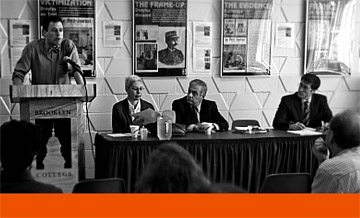 Global Anti-Semitism: Robert D. Johnson, History (at podium); Global Anti-Semitism: Robert D. Johnson, History (at podium);Sara Reguer, Judaic Studies; Mervin Verbit, Sociology; and Steven Remy, History. Ovid. He held his audience rapt as he acted out the readings in a range of different voices. Wendy Fairey, English, read from several poets in a soft and lilting voice that captivated listeners. The audience consensus: This was a rich, passionate, powerful, moving experience. Bridging Cultures and Communities through Film featured Irina Patkanian, Television and Radio, who screened portions of her film "My American Neighbor." The film is a series of vignettes of transplanted Americans, among whom are an artist and a cowboy in Russia, a philanthropist and volunteer in Costa Rica, and an archaeologist in France. The filmmaker's goal is to depict Americans not as immigrants but as neighbors in their new countries and explore their motives and reasons for leaving America. The film is a work in progress, and Patkanian plans to continue filming in Greece, Italy, and Turkey "in search of simple people leading simple lives."
|
|||||||||||||||||

 Roundtables

|
|
|
|
|
| 9 to 9:15 a.m. Refreshments Penthouse, Seventh Floor 9:15 to 9:45 a.m. Opening Remarks Penthouse, Seventh Floor Vanessa Yingling, Physical Education and Exercise Science Provost Roberta S. Matthews, English 10 to 11:15 a.m. Symposia Paying Attention: Narrative and Perception in Hitchcock’s “Rear Window” State Lounge, Fifth Floor Session Moderator: Geoffrey Minter, English Ellen Tremper, English, “A Rear View of ‘Rear Window’” Lindley Hanlon, Film, “How We See It” Bill Seeley, Philosophy, “Imagining Film: Seeing with the Mind’s Eye” Crossing Boundaries: Building Learning Communities through Curriculum Jefferson-Williams Lounge, Fourth Floor Session Moderator: Ellen Belton, English Dorothy Kehl, English, and Nehru Cherukupalli, Geology, “Language and Content in Science: A Two-Way Acceleration for ESL” Julia Hirsch, English; Ray Allen, Conservatory of Music; and Joseph Entin, English, “Voices Across America: Literature and Music” Media Diversity Past and Present and the Federal Communications Commission Maroney-Leddy Lounge, Fourth Floor Session Moderator: Tomás López-Pumarejo, Economics Timothy Shortell, Sociology, “The Black Press in New York City in the Nineteenth Century” Frederick Wasser, Television and Radio, “Do We Need a ‘Fairness Doctrine’ in the Media Age?” George Rodman, Television and Radio, “Deregulation and the Rise of the Media Monoliths” 11:30 a.m. to 12:45 p.m. Symposia Peaceful Teaching, Teaching Peace: Finding Alternative Models for Learners in the American Classroom State Lounge, Fifth Floor Session Moderator: Elaine Brooks, English Roni Natov, English, “The Inclusive Classroom: An Alternative Model to Competition and Ranking” Geri DeLuca, English, “Yoga and the Rhetoric of Radical Self-Acceptance” Len Fox, English, “‘Making Peace’: A Peace Education Textbook” David Forbes, School of Education, “Contemplative Practice in the Urban Classroom” Models of the Mind: Artificial Intelligence as Philosophy and Psychology Occidental Lounge, Fifth Floor Session Moderator: Arthur Reber, Psychology Samir Chopra, Computer and Information Science, “‘Verum est factum convertur’: Artificial Intelligence as Cognitive Science” Robert Lurz, Philosophy, “Philosophy of Mind and Artificial Intelligence” Aaron Kozbelt, Psychology, “Artificial Intelligence and Natural Intelligence” Global Anti-Semitism: Sources and Prospects Maroney-Leddy Lounge, Fourth Floor Session Moderator: Sara Reguer, Judaic Studies Mervin F. Verbit, Sociology, “Antisemitism and anti-Zionism” Robert D. Johnson, History, “Confronting Anti-Israel Attitudes on Contemporary College Campuses” Steven P. Remy, History, “Anti-Semitism in Contemporary Europe” Understanding History: The Values of Interview and Survey Research Jefferson-Williams Lounge, Fourth Floor Session Moderator: Jocelyn Wills, History Philip Napoli, History, “War Talk: Brooklyn’s Vietnam Veterans Remember” Alex Vitale, Sociology, “Challenges in Interviewing Government Officials: Investigating the Origins of ‘Quality of Life’ Policing” Robert Cherry, Economics, “Contentious History: Perceptions of Polish-Jewish Relations during World War II” 12:45 to 2:15 p.m. Lunch, Posters, Roundtables Posters Maroon Room, Sixth Floor 1. Dietary Fat Composition Affects Insulin Resistance Independent of Caloric Intake Kathleen Axen, Health and Nutrition Sciences Amit Khaneja, Health and Nutrition Sciences 2. Adipose and Nonadipose Fuel Stores in Obese Rats: Effects of Fasting and Diet Composition Kenneth Axen, Health and Nutrition Sciences Stan Vinokur, Health and Nutrition Sciences 3. P Wave Morphology During Sub-Maximal Exercise Is Predictive of Coronary Artery Disease Christopher Dunbar, Physical Education and Exercise Science Barry I. Saul, Cardiac Stress Laboratory, New York Methodist Hospital John Kassotis, Electrophysiology Laboratory, New York Methodist Hospital Lizzette Badillo, Graduate Student, Physical Education and Exercise Science 4. Using Digital Camcorders and iMovie in the Classroom Barbara Rosenfeld, School of Education Carolina Mancuso, School of Education 5. Community Health Internship Programs in the Department of Health and Nutrition Sciences: A Preliminary Report of Process and Outcome Catherine D. Stayton, Health and Nutrition Sciences Raymond Weston, Health and Nutrition Sciences 6. Museum Lighting: What Is the Optimal Illuminant? Israel Abramov, Psychology James Gordon, Psychology, Hunter College Michael Scuello, Psychology Steven Weintraub, Art Preservation Services, New York 7. The Brooklyn College Library Forges International Library Relations: The Open World Russian Leadership Program Comes to Brooklyn, Fall 2003 Beth Evans, Library Paraskeva Dimova, Library Alex Rudshteyn, Library 8. Does Antihypertensive Medication Cause Pulse Pressure to Become a Strong Predictor of Cardiovascular Mortality? James Greenberg, Health and Nutrition Sciences Polina Rosen, Student, CUNY Honors College, Coordinated B.A.-M.D. Program 9. The Study of Human Gross Anatomy: A Comparison of Academic Performance among Students Pursuing Select Professional Goals Anthony Sgherza, Physical Education and Exercise Science Sama Ahsan, Student, Coordinated B.A.-M.D. Program 10. Speech Breathing and Vocal Function in Dysphonic Clients Before and After Therapy Natalie Schaeffer, Speech Communication Arts and Sciences 11. Chondrichthyans of the Fairpoint Member of the Fox Hills Formation (Maastrichtian), Meade County, South Dakota John Chamberlain, Geology 12. Dinoflagellates of the Fox Hills Formation (Maastrichtian), Badlands Area of South Dakota: Biostratigraphic and Paleoenvironmental Implications John Chamberlain, Geology 13. Creativity Over the Lifespan in Classical Composers Aaron Kozbelt, Psychology 14. Authors’ Corner Barbra Higginbotham, Library Jane Cramer, Library Sally Bowdoin, Library 15. Self-Efficacy and Locus of Control: Interactive Effects on Academic Achievement Manuel Martinez-Pons, School of Education Natasha Gregory, Student, CUNY Graduate School and University Center 16. World View: Academic Self-Regulation and Academic Achievement in College Students Manuel Martinez-Pons, School of Education 17. Validity and Reliability Testing of a “Stages of Change” Assessment Instrument for Type 2 Diabetes Janet K. Grommet, Health and Nutrition Sciences Claudia Shwide-Slavin, Nutrition and Diabetes Private Practice, New York, N.Y. 18. Mutable Influences on Intimate Partner Abuse Screening in Health Care Settings: A Synthesis of the Literature Catherine D. Stayton, Health and Nutrition Sciences Mary M. Duncan, Department of Community Medicine and Health Care, University of Connecticut Health Center 19. Can Blueberries Improve Cognitive Function in the Elderly? Results of the 2002 Blueberry Health Study Roseanne Schnoll, Health and Nutrition Sciences Rolf Martin, MMT Corp., Sherman, Conn. Kurt E. Gerstmann, Hospital for Joint Diseases, New York, N.Y. James A. Joseph, Human Nutrition Research Center on Aging, Tufts University, Boston, Mass. Bruce Kristal, Burke Medical Research Institute, White Plains, N.Y. Alex Pruchnicki, Mount Sinai Medical Center, New York, N.Y. 20. Tangible User Interfaces in Educational Applications Lori Scarlatos, Computer and Information Science Eleanor Miele, School of Education Roundtables Gold Room, Sixth Floor 1. Heritage Languages at Brooklyn College: Can Languages We Leave Behind Continue to Affect Our Lives? Kenneth Bruffee, English, Honors Academy Mariana Regalado, Library Eugene Shenderov, Student, Honors Academy 2. New Directions in Interdisciplinary Work Martha Nadell, English James Davis, English Joseph Entin, English Geoffrey Minter, English 3. Yes, It Is Serious Scholarship!: The Multiple Literacies of Popular Culture Priya Parmar, School of Education Shirley Steinberg, School of Education Kristine Quail, School of Education 4. Looking Ahead: The Future for Science at Brooklyn College Louise Hainline, Psychology Micha Tomkiewicz, Physics Lori Scarlatos, Computer and Information Science 5. “Yes, In My Backyard”: The Economic and Social Impact of the New Jersey Nets’ Move to Brooklyn Jerome Krase, Sociology Robert Cherry, Economics Thomas Boyle, English 6. Report from a Writing Group: How the Group Has Changed Our Lives as Writers Roberta Satow, Sociology Geri DeLuca, English Julia Hirsch, English 7. A Bite of the Apple: Online Teacher Preparation Deborah Shanley, School of Education Kathleen McSorley, School of Education Eleanor Miele, School of Education Lisa Novemsky, School of Education 8. Should the Brooklyn College Curriculum Include Civic Engagement? Michael Menser, Philosophy Melanie Bush, Sociology Barbara Winslow, School of Education, Women’s Studies Program 9. Putting the Tech in Teaching: Preparing Faculty to Teach with Online Resources Wayne Powell, Geology Lilia Melani, English Danny Kopec, Computer and Information Science 10. Grant Writing 101, No Prerequisites Required Barbara Naso, Office of Research and Sponsored Programs John Jannone, Television and Radio Vanessa Yingling, Physical Education and Exercise Science 2:30 to 3:45 p.m. Artistic Presentations The Poetics of Sound: An Interactive Performance of Sound and Silence Penthouse, Seventh Floor Douglas Cohen, Conservatory of Music George Brunner, Conservatory of Music “The Beautiful Changes”: Performances of Literature about Change State Lounge, Fifth Floor Timothy Gura, Speech Communication Arts and Sciences Wendy Fairey, English Judylee Vivier, Theater In Two: A Work-in-Progress Reading of a Comic Play about the Collision of Academics, Art, and Commerce Jefferson-Williams Lounge, Fourth Floor Dan Gurskis, Film Faculty and students, Theater Bridging Cultures and Communities through Film Maroney-Leddy Lounge, Fourth Floor Irina Patkanian, Television and Radio, “My American Neighbor” Annette Danto, Film, “Community Video: Local and International Examples” 4 to 5:15 p.m. Symposia Public Health without Borders: An International Perspective on Disease State Lounge, Fifth Floor Session Moderator: Leslie Jacobson, Health and Nutrition Sciences Patricia Antoniello, Health and Nutrition Sciences, “Against Women: AIDS, Global Policies, and Health Policies” Jean Grassman, Health and Nutrition Sciences, “The Public Health Problems of Catastrophes: Russia, Italy, and the United States” Gerald Oppenheimer, Health and Nutrition Sciences, “Shattered Dreams: Confronting the AIDS Epidemic in South Africa and the United States” Rethinking the Ideal of Objectivity in Journalism Alumni Lounge, Fourth Floor Session Moderator: Hal Himmelstein, Television and Radio Tanni Haas, Speech Communication Arts and Sciences, “Alternatives to the Ideal of Objectivity in Journalism” Katherine Fry, Television and Radio, “Objectivity: No Such Thing” Mark Fishman, Sociology, “Objectivity in Journalism: An Ideal Teetering on the Edge” Trying to Make Smaller Better: A Case Study in High School Reform Jefferson-Williams Lounge, Fourth Floor Session Moderator: Stephen Phillips, School of Education Hollyce Giles, School of Education, “The Uses of Community in a Democratic Reform Initiative” Peter Taubman: School of Education, “The Corporate Politics of School Reform” Nancy Romer: Psychology, “Supporting the Whole: Providing Services to the Entire School through Service Learning” 5:30 to 6 p.m. Awards Ceremony Penthouse, Seventh Floor 6 to 7 p.m. Faculty Reception Oriental-Occidental Lounge, Fifth Floor |